Amundsen–Scott South Pole Station
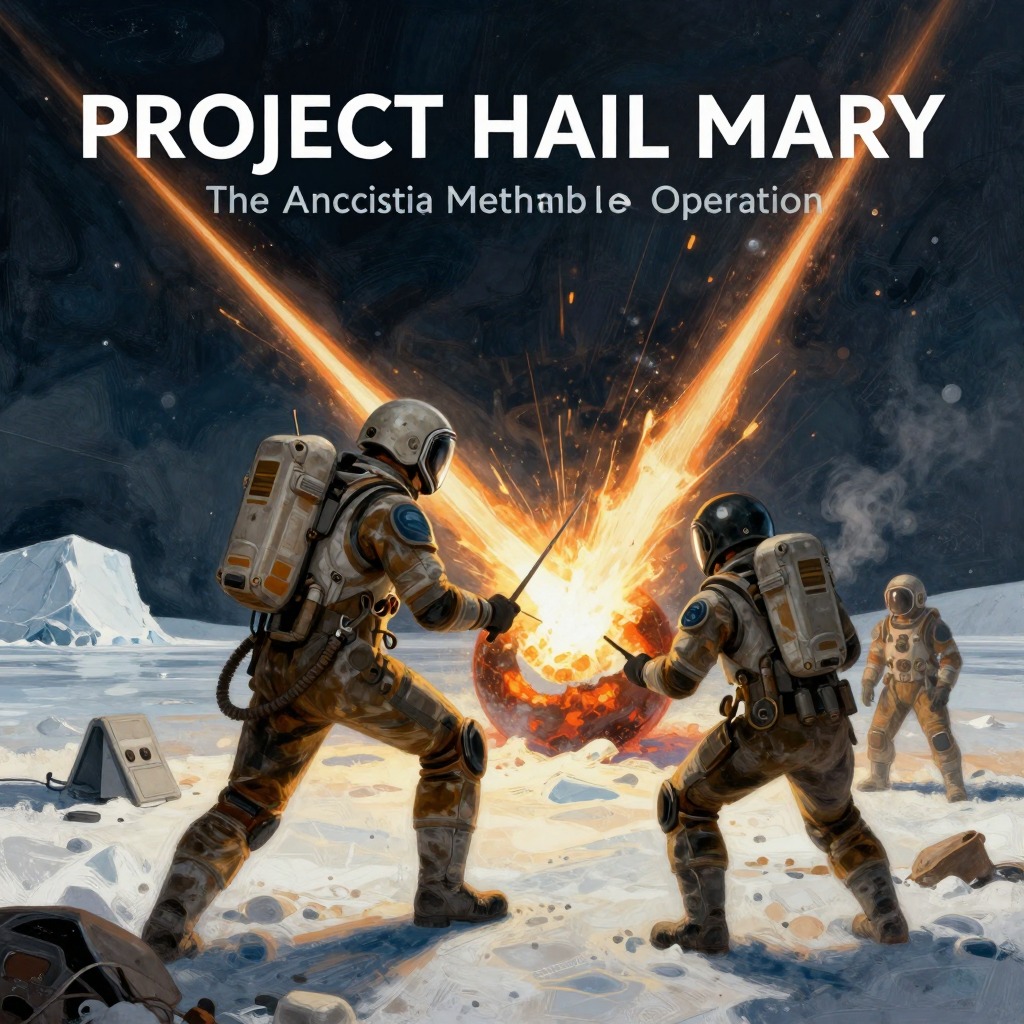
Amundsen–Scott South Pole Station, the American scientific outpost at the geographic South Pole, becomes the epicenter of one of the most drastic geoengineering operations in human history: a coordinated nuclear strike on the Antarctic ice sheet ordered by Eva Stratt and executed by climatologist François Leclerc to release massive quantities of methane into the atmosphere, buying Earth a few extra decades against the Astrophage-driven solar dimming.
Location and Strategic Significance
Amundsen–Scott South Pole Station sits on the Antarctic Plateau, a roiling mass of ice and snow that is itself a giant glacier slowly marching toward the sea. The region contains hundreds of thousands of square kilometers of ice, and beneath that ice lies a geological legacy: Antarctica was once a lush jungle, and the decomposition of that ancient plant life trapped enormous quantities of methane—a greenhouse gas far more powerful than carbon dioxide—in the frozen layers. When Leclerc briefs Stratt and the science team aboard the aircraft carrier anchored off the western Antarctic coast, he explains that the continent has been entirely evacuated of humans, with the station itself 1,500 kilometers from the blast zone—an overreaction, he admits, but one that eliminates any risk to personnel.
The Nuclear Strike and Its Rationale
Leclerc, a lifelong environmental activist and climatologist who describes himself as a "tree-hugging antiwar throwback," finds himself in the unimaginable position of ordering 241 nuclear weapons—all fusion bombs provided by the United States—buried 50 meters deep along a fissure at three-kilometer intervals and detonated simultaneously. The explosions are designed to cleave the ice shelf along the line of detonation, allowing the broken ice to slowly work its way into the sea and melt. As the ice melts, the trapped methane is released into the atmosphere, creating a greenhouse blanket that will retain solar heat and slow the onset of catastrophic global cooling. Leclerc estimates that the methane will break down naturally after about ten years, meaning that if the Hail Mary mission succeeds, humanity can simply wait for the gas to dissipate—unlike carbon dioxide, which persists for centuries.
Consequences and Aftermath
The immediate effect of the detonation is invisible from the carrier: no flash, no explosion, not even a sound. Leclerc watches his tablet and announces that the nukes have detonated; the shockwave, he predicts, will arrive in about ten minutes as distant thunder. The long-term consequences are severe but calculated: sea levels will rise about a centimeter over the following month, ocean temperature will drop a full degree—itself an ecological disaster—and the disruption to global weather patterns will be massive. Leclerc warns that the methane is a stopgap at best, that crop failures, biome annihilation, and horrific weather will continue, but that the alternative—doing nothing—means half the human population dead within nineteen years. Stratt, standing beside him, puts a hand on his shoulder and tells him he did what he had to do; he buries his face in his hands and cries.
Narrative Significance
The Antarctic operation crystallizes the moral calculus that defines Stratt's leadership: when the alternative is extinction, there are no moral dilemmas, only a single-minded focus on survival. Leclerc, who spent his entire career trying to prevent environmental catastrophe, is forced to become the agent of a deliberate environmental manipulation on a scale that dwarfs any previous human intervention. The scene also underscores the time pressure driving the entire Hail Mary project—the methane buy gives Earth perhaps twenty-seven years, the absolute minimum needed for the mission to Tau Ceti and for any data to return. The station itself, evacuated and silent, becomes a symbol of the sacrifices required: a place built for scientific discovery repurposed as a demolition site, its isolation and emptiness reflecting the loneliness of the decisions being made far from any human witness.